Quick Facts
- Primary Cause of Drift: Dull blades creating uneven resistance or misaligned baseplate shoes.
- Depth Rule: Set blade depth to material thickness plus 1/8 to 1/4 inch.
- Blade Tolerance: Industry standard runout should be less than 0.005 inches on a 10-inch plate.
- Essential Tool: A combination square for parallelism calibration.
- Safety Stat: Improper maintenance contributes to 14% to 34% of workplace saw injuries.
- Pro Tip: Use a scoring knife to create a starter notch for the kerf.
A circular saw often fails to make a circular saw straight cut due to a dull blade or a baseplate shoe that isn't parallel to the blade. To stop drifting, ensure your circular saw blade alignment is square to the base and the workpiece is properly supported to prevent binding. Understanding why does my circular saw blade drift is the first step toward achieving professional-grade results in your workshop.
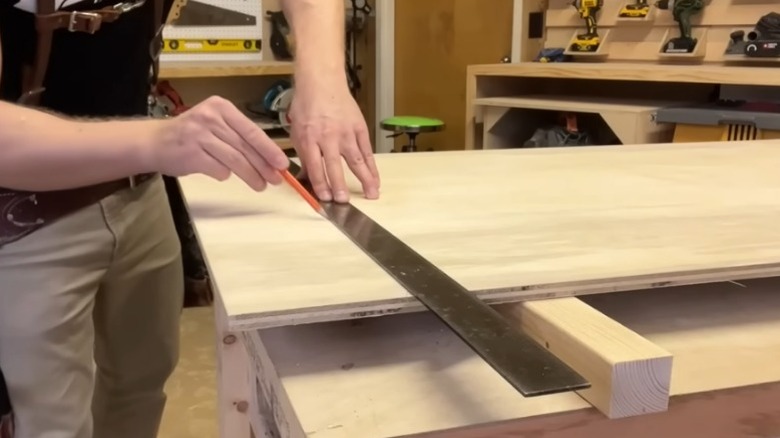
Diagnosing the Drift: Why Your Saw Wanders
When your saw begins to veer off course, it is rarely a ghost in the machine. Most often, the culprit is the blade itself. Identifying the signs of a dull circular saw blade causing crooked cuts is essential for any DIYer. A dull blade does not slice through wood fibers cleanly; instead, it chops at them, creating uneven resistance. This resistance forces the saw to take the path of least resistance, which is usually a curved line away from your intended path.
Think of your saw blade like a tractor-trailer on a highway. If the wheels are aligned and the engine is strong, it stays in its lane. However, if the tires are flat on one side, the vehicle naturally pulls in that direction. In technical terms, this is often caused by blade wobble or issues within the arbor assembly. If the arbor—the shaft that holds the blade—is loose or damaged, the blade will flutter. According to the U.S. Department of Labor, improper tool maintenance and operator error are leading factors in power saw accidents, which account for 14% to 34% of all traumatic workplace injuries. Keeping your equipment in peak condition is not just about the quality of the cut; it is about your personal safety.
Another factor is blade deflection. This happens when a thin blade encounters a hard knot or dense grain and literally bends under the pressure. While you might try to force the saw back onto the line, applying lateral pressure only makes the problem worse. The more you fight the saw, the more the blade binds, increasing the risk of a dangerous kickback.
Mechanical Fixes: Calibrating the Saw
Before you blame your steady hand, you need to look at the mechanical alignment of the tool. Even a brand-new saw out of the box can have a baseplate shoe that is not perfectly parallel to the blade. This misalignment means that even if you follow a guide rail, the blade is effectively "crabbing" through the wood, constantly trying to steer away from the fence.
To fix this, you must learn how to align circular saw blade to base using a process called parallelism calibration. First, ensure the saw is unplugged. Raise the blade to its maximum depth and use a combination square to measure the distance from the front edge of the blade to the edge of the baseplate shoe. Then, measure the distance at the back of the blade. These two measurements must be identical. Industry standards for saw maintenance suggest that blade runout should ideally be less than 0.005 inches on a 10-inch plate to prevent wobbling and ensure a straight cut.
If you find a discrepancy, consult your manual to see if your saw has adjustment screws for the baseplate. If it doesn't, you may need to slightly loosen the mounting bolts, tap the base into alignment, and retighten them. While you are at it, check the arbor assembly for stability. Tighten the mounting nut if you notice any play. A stable, square blade is the only way to guarantee a circular saw blade alignment that produces repeatable, accurate results.
Mastering the Cut: Guides vs. Freehand
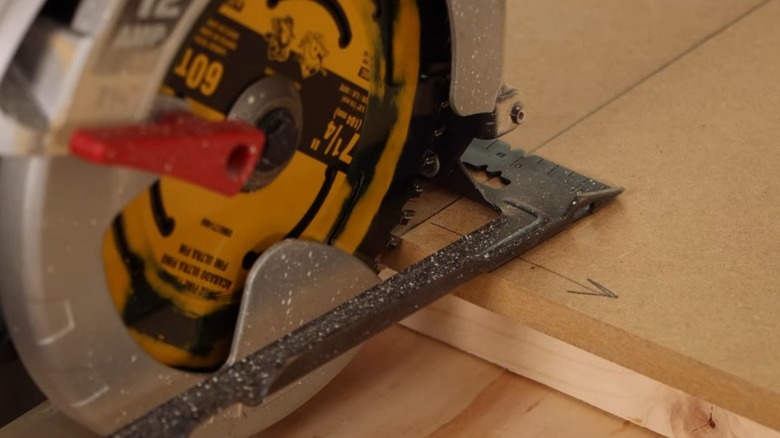
Once your hardware is calibrated, the focus shifts to technique. Many beginners rely solely on the small notch at the front of the saw’s base. However, that notch is often just an approximation. For true precision, you need to understand where the kerf—the width of the cut made by the blade—actually falls.
For long rips in large boards, using a circular saw cutting guide for plywood is the gold standard. You can buy commercial tracks or simply clamp a straight factory-edged piece of wood to your workpiece. This removes the "human element" of steering. However, there are many times when a guide isn't practical, and you must rely on freehand circular saw technique.
Pro Tip: The Utility Knife Trick Instead of using a thick carpenter's pencil, use a utility knife to score your cut line. This creates a physical groove for the blade to follow. Furthermore, it severs the top wood fibers, significantly reducing wood tear-out and leaving you with a crisp, professional edge.
When making straight cuts with circular saw no guide, your eyes should not be on the guide notch. Instead, look at the point where the front of the blade meets your line. To master freehand circular saw cutting techniques, start the saw and let it reach full speed before touching the wood. Keep a steady, forward momentum. If you notice the saw starting to drift, do not try to twist it back. Instead, stop, let the blade come to a complete halt, and reset the cut.
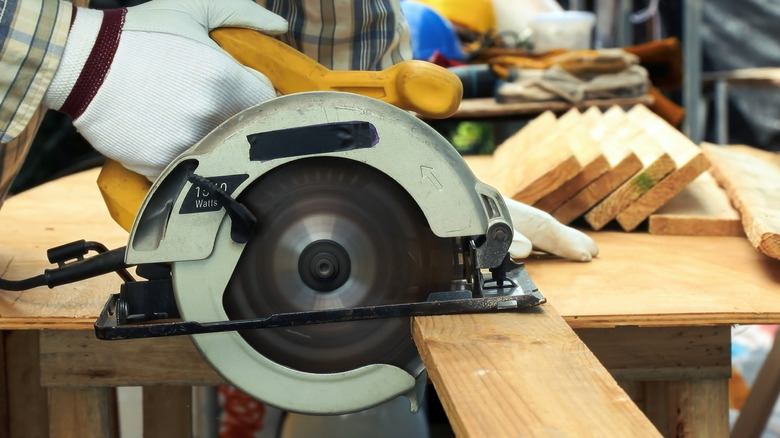
Pro Setup for Stability and Safety
A circular saw straight cut is as much about how the wood is supported as it is about how the saw is held. If the wood sags in the middle during a cut, it will pinch the blade. This leads to burned edges, crooked lines, and potential kickback. To avoid this, use a sacrificial piece of rigid foam support under your sheet goods. Placing a 1-inch thick sheet of rigid foam on the floor or a workbench allows you to cut right through the plywood and slightly into the foam, supporting the wood across its entire surface.
The depth of your blade also plays a role in accuracy and safety. Many users set the blade as deep as it will go, but this exposes more of the blade surface to the wood, increasing friction. To achieve optimal control and accuracy, the recommended setting for a circular saw's cutting depth is the thickness of the workpiece plus an additional 1/8 to 1/4 inch. This depth allows the teeth to clear the waste efficiently without creating unnecessary drag.
Finally, always manage your sheet goods handling by ensuring the waste side of the cut is free to fall away or is supported at the same height as the "keep" side. If the waste side drops prematurely, it can snap the last bit of wood, creating a jagged break that ruins your straight line. By combining proper support, correct depth, and a calibrated tool, you can turn a notoriously "rough" tool into a precision instrument.
FAQ
How do I stop my circular saw from drifting?
To stop the drift, start by replacing the blade if it is dull, as uneven sharpness causes the saw to pull to one side. Ensure your baseplate shoe is parallel to the blade using a combination square. When cutting, avoid applying sideways pressure and let the saw’s forward momentum do the work. Proper workpiece support is also vital to prevent the wood from pinching the blade.
How do you cut a perfectly straight line with a circular saw?
The most reliable way is to use a circular saw cutting guide, such as a clamped straight edge or a dedicated track system. Align the guide so that the blade's kerf falls exactly on the waste side of your line. For freehand cuts, mark your line with a scoring knife and keep your focus on the front of the blade where it meets the wood, rather than the built-in guide markers.
Can you make a straight cut with a circular saw without a jig?
Yes, you can achieve a straight cut freehand by utilizing proper body mechanics and visual cues. Stand so you can clearly see the blade meeting the line, and use a wide stance for stability. Using a sharp, high-quality blade and maintaining a slow, consistent feed rate allows the surface area of the blade itself to act as a stabilizer within the cut.
What side of the line do you cut with a circular saw?
You should always cut on the waste side of your marked line. The blade removes a small amount of material, known as the kerf (usually about 1/8 inch). If you cut directly on the line or on the "keep" side, your finished piece will be shorter than intended. Clearly mark which side of the line is the waste before you pull the trigger.
Why is my circular saw blade wandering?
Wandering is usually caused by a misaligned arbor assembly or a blade that has warped due to heat. It can also happen if the operator tries to correct a minor deviation by twisting the handle, which causes the back of the blade to bite into the wood. Ensure the blade is securely fastened and that the baseplate is not bent or loose.