Our Top Picks
- Top Successor: Acme Weather app for iPhone
- Best Feature: Alternate Predictions/Uncertainty Visualization
- Best for Utility: Waze-style community reports
- Best for Privacy: Strict no-tracking policy
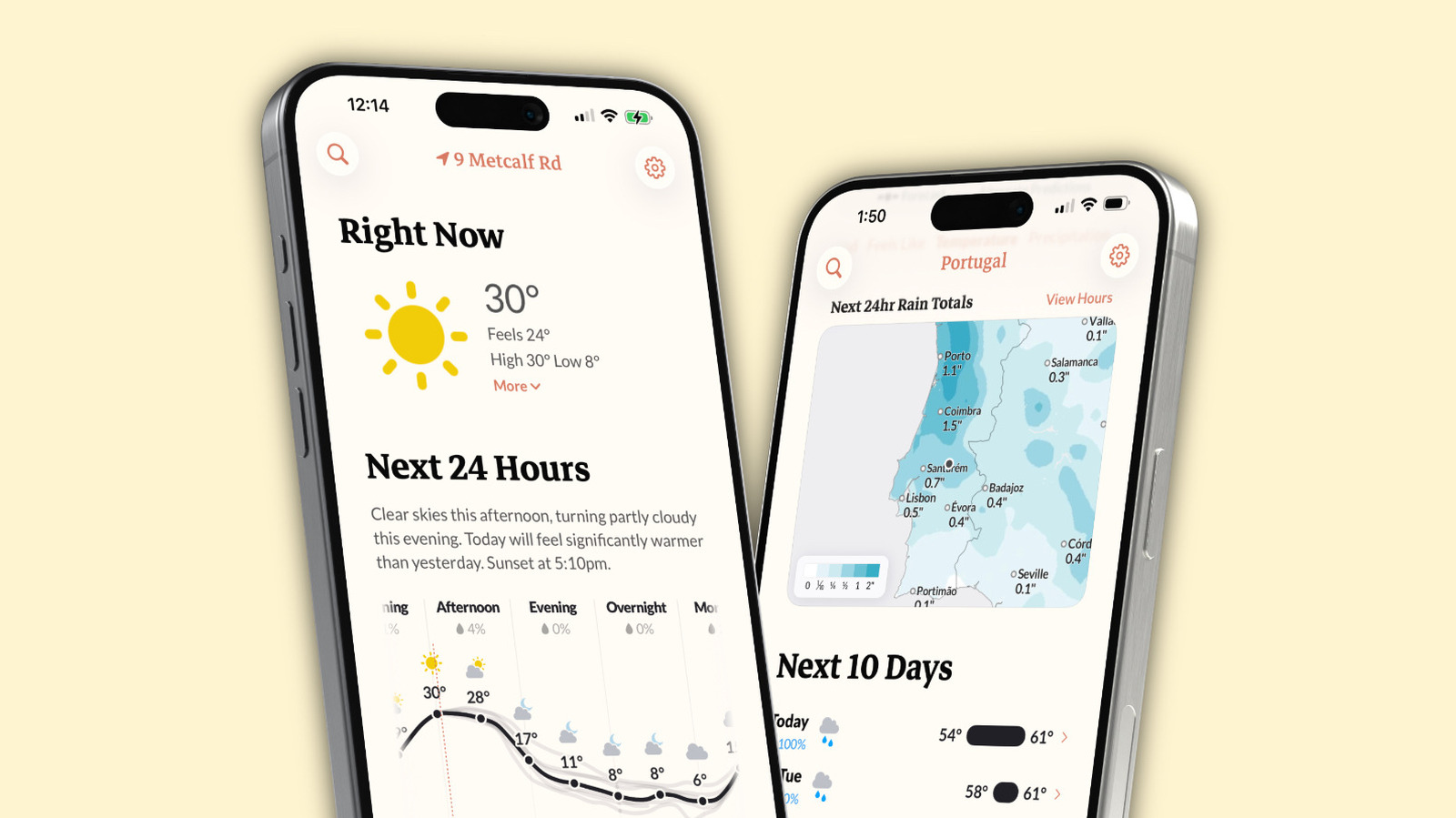
The Acme Weather app is widely considered the best Dark Sky replacement for iPhone because it replaces single-guess forecasts with ensemble forecasting and alternate futures to show true meteorological uncertainty. This approach provides hyper-local precision and helps users understand the reliability of a forecast, particularly for precipitation timing and shifting microclimates that standard apps might miss.
The Dark Sky Legacy: Why the Original Team Returned
For years, Dark Sky was the gold standard for hyper-local weather. Its hyper-precise rain alerts were so reliable that many iPhone users felt a genuine sense of loss when the app was officially shut down on January 1, 2023 following its acquisition by Apple. While Apple Weather integrated much of the Dark Sky technology, many power users felt the soul of the experience—the scrappy, data-first philosophy—was missing.
In February 2026, the original founders of Dark Sky launched Acme Weather, a premium weather service designed to fix the problem of over-certainty in modern apps. Most weather apps provide a single icon and a single percentage, which often leads to frustration when a forecast is off by just a few miles or minutes. Acme Weather returns to its roots as a premium weather service but introduces a radical new way to look at atmospheric data.
The benefits of Acme Weather for former Dark Sky users are immediately apparent. It maintains the clean, iOS-centric aesthetic while re-introducing the "scrappy shop" innovation that made the original app a cult classic. The team realized that providing a single number for the chance of rain is often an over-confident guess. Instead, they wanted to give users the same tools professional meteorologists use to understand the range of possible outcomes.
Visualizing Uncertainty: How Acme Weather Alternate Futures Work
The standout feature of this new experience is the unique Alternate Predictions tool, which visualizes meteorological uncertainty instead of giving you a single, potentially wrong answer. To understand how Acme Weather alternate futures work, think of it like looking for a route on Google Maps. Maps doesn't just show one path; it shows alternate routes that might be faster or slower depending on traffic.
Acme Weather applies this logic to the atmosphere using ensemble forecasting. Instead of running one numerical weather prediction model, the app looks at dozens of different simulations. In the interface, this appears as a series of forecast lines. When the lines are tightly grouped, you can be highly confident in the forecast. When the lines spread out like a frayed rope, it signals atmospheric chaos, telling you that the precipitation timing or temperature could vary wildly.
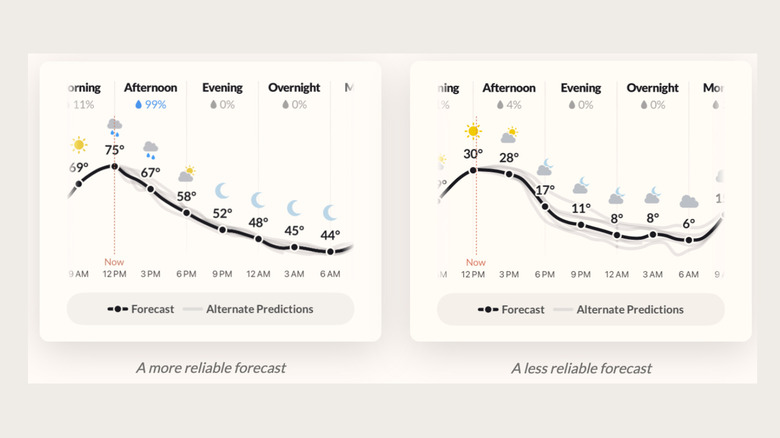
This visual "line spread" is a game-changer for anyone who has ever been caught in a "0% chance of rain" downpour. By seeing the alternate futures, you can see that while the primary model predicts a clear day, three other models are suggesting a heavy storm. This predictive modeling allows you to make better decisions based on the risk you are willing to take.
A Waze for Weather: Leveraging Acme Weather Community Reports
If ensemble models are the "satellite view" of the weather, Acme Weather community reports are the "street view." The app features a unique community reporting system that functions much like a navigation app for weather. It allows for crowdsourced observations of local conditions, turning every iPhone user into a mobile weather station.
Users can submit real-time telemetry regarding rain, snow, or cloud cover in their specific area with a quick tap. If you are standing in a microclimate—like the foggy hills of San Francisco or a sudden sun-shower in Miami—you can report that ground truth to the system. This data supplements standard numerical weather prediction models to provide localized conditions that are far more accurate than what a distant airport sensor might report.
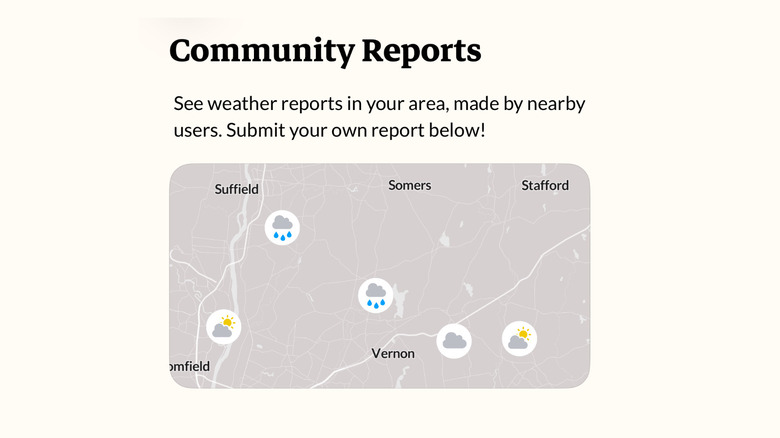
The Acme Weather community reporting features create a feedback loop. When multiple people in a specific neighborhood report "light rain," the app can update its hyper-local precision alerts for everyone else nearby. It is essentially real-time telemetry for the sky, bridging the gap between high-altitude satellite data and what is actually happening on your driveway.
Standard App vs. Acme Weather
| Feature | Standard Weather Apps | Acme Weather App |
|---|---|---|
| Forecast Method | Single Deterministic Model | Ensemble Forecasting |
| Data Visualization | Static Icons & Percentages | Interactive Alternate Futures |
| Local Accuracy | Regional Sensors | Crowdsourced Observations |
| Privacy | Often Sells Location Data | Strict No-Tracking Policy |
| Alerts | Government-issued only | Proactive & Labs-based |
Beyond Utility: Interactive Radar and Acme Labs
For the tech-enthusiasts and outdoor hobbyists, the app includes a section called Acme Labs. This is where the developers experiment with specialized alerts that go beyond standard storm tracking. You can toggle on notifications for "Perfect Sunsets" or "Rainbow Potential," which use atmospheric data to predict when the lighting and moisture levels are just right for photography.
The app also features some of the most fluid interactive radar layers available on the iPhone. You can scrub through time to see the progression of storms with incredible detail, utilizing high-resolution lightning maps to see exactly where strikes are occurring in real-time. Whether you are an enthusiast trying to time a hike or a photographer chasing the light, these tools provide a level of technical depth that standard apps simply cannot match.
Pricing and Availability: Is Acme Weather Subscription Worth It?
Quality data and independent development come at a price. The Acme Weather app requires an annual subscription fee of $25 following a 14-day free trial. Currently, the service is available for iPhone users in the United States and Canada, with an Android version still under development.
While $25 a year might seem steep for a weather app, you have to consider what you are paying for. Most free weather apps monetize by selling your precise location data to advertisers. Acme Weather operates on a strict no-tracking privacy policy. You are paying for the ensemble forecasting compute power and a service that doesn't treat your movements as a product.
For many, the question of is Acme Weather subscription worth it comes down to how much you value your time. If knowing the exact window of a rain gap saves you from a ruined commute or a cancelled event once a month, the app pays for itself.
FAQ
Is the Acme Weather app free to use?
The app is not permanently free. It offers a 14-day free trial to allow users to test the ensemble forecasting and community features, after which it requires a $25 annual subscription.
How accurate is the Acme Weather app for local forecasts?
By using ensemble forecasting and crowdsourced observations, the app provides a higher degree of hyper-local precision than standard models, particularly in complex microclimates where traditional data might be lacking.
Does Acme Weather provide real-time severe weather alerts?
Yes, the app provides highly customizable proactive notifications for severe weather conditions, including lightning strikes, precipitation timing, and standard government weather warnings.
What are the differences between the free and premium versions of Acme Weather?
There is no ongoing free version; the app operates on a subscription model. The premium subscription unlocks all features including interactive radar layers, alternate futures visualization, and Acme Labs alerts.
Is Acme Weather available for both Android and iPhone?
Currently, the app is only available for iPhone users in the United States and Canada. The developers have stated that an Android version is currently under development.
Does Acme Weather offer hyper-local radar features?
Yes, the app includes advanced interactive radar layers that allow users to track storms and precipitation with high-resolution data and specialized lightning maps.
Final Verdict
If you have been searching for a Dark Sky replacement for iPhone that captures the original's spirit of innovation, Acme Weather is the clear winner. It doesn't just tell you it might rain; it shows you why the atmosphere is uncertain and gives you the tools to decide for yourself. While the subscription fee is a factor, the combination of alternate futures, community reporting, and a commitment to privacy makes it an essential tool for any weather-conscious iPhone user.