Quick Facts
- Primary Use: IEMs are tailored for analytical monitoring and critical listening, whereas consumer earbuds are built for casual daily convenience.
- Isolation: High-quality IEMs offer 20-40 dB passive noise reduction by creating a physical seal, working without the need for batteries.
- Drivers: Professional IEMs frequently employ multiple balanced armature or hybrid driver configurations to separate frequency bands.
- Repairability: The majority of IEMs use a removable cable system, typically utilizing MMCX or 2-pin connectors to prevent total device failure from a broken wire.
- Comfort: Consumer earbuds provide a pressure-free fit on the outer ear, while IEMs require a secure seal within the canal to produce accurate bass.
- Market Trend: Wired IEMs continue to hold a 56.1% share of the specialized monitor market as high-fidelity audio demand remains strong.
IEM vs Earbuds. IEMs (in-ear monitors) are designed to sit deep inside the ear canal to create an airtight seal, providing superior passive noise isolation and a focused soundstage. While consumer earbuds often rest on the outer ear and feature bass-heavy tuning for casual listening, IEMs typically offer a flatter, more analytical frequency response favored by audio professionals for detailed monitoring.
Sound Signatures: Accuracy vs. Consumer Coloration
When I talk to people about the jump from standard wired earbuds to their first pair of in-ear monitors, I often use the race car versus luxury car analogy. A consumer earbud is like a luxury SUV—it is tuned to make the road feel smooth. It often features a V-shaped sound signature, which means the bass is boosted for that extra thump and the treble is sharpened for clarity. This makes pop and hip-hop sound exciting, but it often masks the finer details of the recording.
In contrast, an IEM is like a high-performance race car. It is built for feedback. The goal of neutral tuning is to let you hear exactly what was recorded, for better or worse. This studio reference approach allows audio engineers and musicians to hear the placement of every instrument and the subtle decay of a reverb tail. Because they provide such a focused soundstage imaging, you aren't just hearing the music; you are seeing the architecture of the sound.
One thing that often catches beginners off guard is the power requirement. While most IEMs have low impedance and high sensitivity, allowing them to run from a standard 3.5mm jack or a simple dongle, the question of do i need a dac for iems vs consumer earbuds often comes up. A dedicated DAC (Digital-to-Analog Converter) can significantly enhance the experience by reducing floor noise and providing a cleaner signal. This is essential for hearing the micro-details and high-resolution audio that premium IEM drivers are designed to reproduce. If you are chasing sound signature differences that define high-end audio, a clean source is just as important as the monitors themselves.
Whether you are using dynamic drivers for their natural, punchy bass or balanced armature drivers for their lightning-fast precision, the sound quality of an IEM is inherently more analytical. It is about transparency rather than just making the music "sound good." For many, this clarity is a revelation, revealing layers in favorite songs that were previously buried under the consumer-grade mud.

Build Quality and Longevity: Why IEMs Last Longer
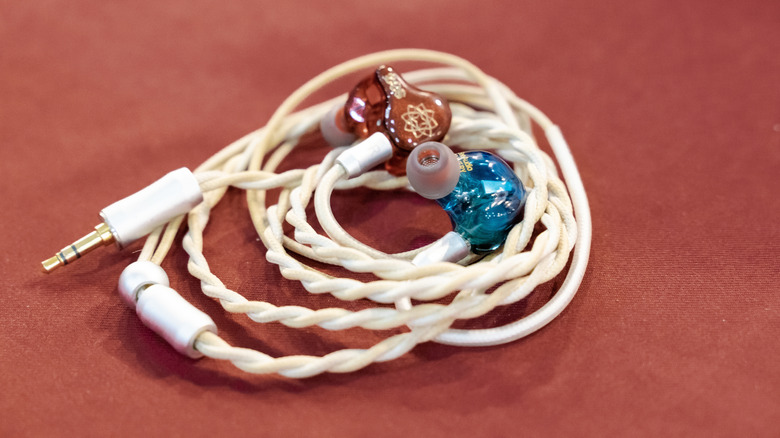
One of the most frustrating things about consumer electronics is the planned obsolescence. If the wire on your old white earbuds frayed near the jack, the whole unit went into the trash. The IEM world operates on a completely different philosophy. Most IEMs utilize a removable cable system, such as MMCX or 2-pin connectors, to extend the lifespan of the product and allow for easy replacements or upgrades.
This modularity is a massive part of the benefits of removable cables in iems vs fixed earbuds. It is not just about repair; it is about customization. Audiophiles often swap out stock cables for silver-plated copper or balanced 4.4mm cables to fine-tune their setup. Furthermore, the physical construction of the shells often involves exotic materials like zinc alloy, resin, or even machined brass. When you hold a pair of professional monitors, they feel like tools, not toys.
The global in-ear monitor (IEM) market, valued at approximately USD 393.57 million in 2024, is projected to reach USD 663.55 million by 2034, expanding at a compound annual growth rate (CAGR) of 5.37%. This growth is driven by the fact that users are starting to value longevity over the convenience of disposable tech. Even when looking for the best budget iems for beginners 2026, you will find that the entry-level price point of around $20 to $50 now offers metal housings and detachable cables that were once reserved for $500 flagship models.
The over-ear cable design also serves a vital functional purpose. By wrapping the cable behind the ear, manufacturers significantly reduce microphonics—that annoying thumping sound you hear when a cable rubs against your shirt. This design also ensures a secure fit, which is critical for both stage performers moving under hot lights and hobbyist audiophiles who want to lose themselves in the music without their earphones falling out.

Ergonomics and Seal: The Fit for Every Ear
If there is one "secret" to getting great sound out of an IEM, it is the seal. Unlike consumer earbuds that just rest in the concha of the ear, an IEM relies on acoustic isolation to function. If you don't have an airtight seal, the bass will completely vanish, and the treble will sound thin and metallic. This is why in-ear monitors for beginners always come with a variety of ear tips, ranging from standard silicone to memory foam ear tips.
Finding the right iem vs earbud fit for small ear canals can be a challenge, but the variety of shell shapes in the IEM market makes it easier than ever. Some manufacturers use ergonomic designs based on thousands of ear scans to create a "custom-lite" fit that sits flush within the ear. Once you find that perfect fit, the performance difference is staggering.
One of the unexpected benefits of this design is what I call the "volume trigger." Because IEMs provide such high levels of passive noise isolation iems vs wired earbuds, you actually don't need to turn the volume up as high to hear all the details. In a noisy environment like a bus or an airplane, you might find yourself cranking consumer earbuds to 80% volume just to hear the melody over the engine drone. With a well-sealed IEM, you can stay at 30% volume and still hear the breath of the vocalist, which is far better for your long-term hearing health.
Pro Use Cases: Gaming and Stage Performance
While IEMs were originally built for musicians to hear themselves on stage, they have found a massive second life in the world of competitive gaming. Gamers are moving toward planar in-ear monitors for gaming vs standard earbuds for a few key reasons. First, there is the issue of heat and pressure. Wearing a heavy over-ear headset for six hours can lead to "gamer neck" and sweaty ears. IEMs offer a weightless alternative that you can wear all day.
Second, the passive noise isolation is often superior to active noise cancellation (ANC) for certain types of noise. In-ear monitors (IEMs) provide significant passive noise isolation by creating a physical seal in the ear canal, typically reducing external noise by 20 to 40 dB without the use of batteries. This allows a gamer to focus entirely on footstep sounds and directional cues without being distracted by the hum of a PC fan or a noisy roommate.
Even though true wireless stereo (TWS) earbuds represented 73% of all smart personal audio shipments in late 2023, the wired segment is estimated to maintain a 56.1% share of the specialized in-ear monitor market by 2026. This is because, in professional and competitive environments, latency is the enemy. A wired connection is instantaneous, providing the reliable performance that pros demand.
FAQ
What is the main difference between IEMs and earbuds?
The primary difference lies in how they fit and how they sound. IEMs are designed to be inserted into the ear canal to create a physical seal, which provides isolation and a more detailed, analytical sound. Consumer earbuds rest on the outer ear, allowing ambient noise to leak in, and are generally tuned for a more casual, bass-heavy listening experience.
Are IEMs better than earbuds for sound quality?
In terms of technical performance, yes. IEMs generally offer better resolution, more accurate frequency response, and superior soundstage imaging. Because they seal the ear canal, they can reproduce sub-bass frequencies and high-end details that are often lost with the loose fit of standard earbuds.
Is it worth buying IEMs for casual music listening?
Absolutely. Many people find that once they experience the clarity of an IEM, they can never go back to standard earbuds. With the rise of affordable high-quality options, you can get a professional-grade sound experience for the same price as a pair of basic consumer earbuds. They are excellent for commuting or working in offices where you want to block out distractions.
Are IEMs better for gaming than standard earbuds?
Yes, especially for competitive gaming where directional audio is key. The precise imaging of IEMs helps you pinpoint exactly where sounds are coming from. Additionally, many gamers prefer them over headsets because they don't cause heat buildup or discomfort during long sessions.
Are IEMs better at blocking out background noise than earbuds?
Yes, by a wide margin. Because IEMs create a physical seal in your ear canal, they offer passive noise isolation that can reduce external sounds by up to 40 dB. This is often more effective at blocking out high-frequency noise (like people talking) than the active noise cancellation found in many wireless earbuds.
If you are ready to take your listening experience to the next level, I highly recommend looking into the best budget iems for beginners 2026. It is a small investment that pays off every time you hit play.