
Quick Facts
- Original Component: 1940s Graflex 3 Cell flash handle originally designed for Speed Graphic press cameras
- Set Decorator: Roger Christian
- Discovery Location: Brunnings Camera Shop, London
- Original Production Cost: Approximately $15 in 1976
- Record Auction Price: $250,000 in 2012 for a screen-used hero prop
- Key Identification Marker: Patent Number 2310165 stamped on the bottom
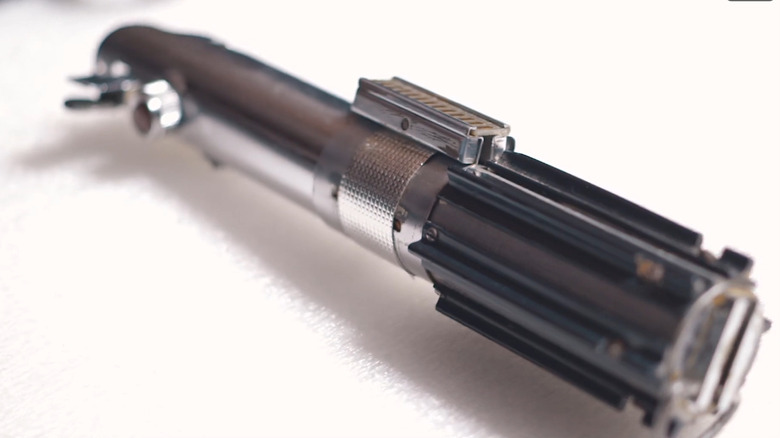
The original Graflex lightsaber was constructed from a vintage Graflex 3 Cell camera flash handle discovered by set decorator Roger Christian. To transform the photography equipment into a movie prop, Christian added black PVC T-track strips for grips, a bubble display strip from a Texas Instruments Exactra 20 calculator, and a small D-ring for a belt attachment.
The Discovery: From Brunnings Camera Shop to Elstree Studios
As an editor who spends my days reviewing the latest mirrorless sensors and ultra-sharp primes, I often find myself looking back at the mid-20th century with a certain reverence. This was an era when camera equipment was built with a tactile, industrial permanence—all chrome-plated brass and heavy-duty toggles. It was exactly this aesthetic that caught the eye of Roger Christian in 1976.
Tasked with outfitting a low-budget space fantasy, Christian was searching for something that avoided the sleek, plastic look of 1960s science fiction. He was looking for items that felt lived-in and mechanical, a concept George Lucas famously termed the used universe design philosophy. Christian’s search led him to Brunnings, a dusty secondhand camera shop in London.
In a box tucked away in the back of the store, he found a handful of chrome handles. These were not weapons from a distant galaxy; they were 1940s Graflex three-cell flash handles meant for the Speed Graphic, the workhorse camera of every mid-century press photographer. Christian immediately recognized that the weight, the reflector mount (which looked like a beam emitter), and the red firing button possessed a regal, knightly quality. He bought the stock for a few pounds each, and the foundation for the Jedi weapon was born.
Upon bringing them back to Elstree Studios, he compared the flash units to Ralph McQuarrie’s early concept art. The match was uncanny. The vintage camera flash lightsaber didn't just look like a movie prop; it looked like a piece of functional machinery from another world.
Anatomy of an Icon: How to Identify Vintage Graflex 3 Cell Flash Units
For the modern collector or prop researcher, identifying an authentic vintage Graflex 3 cell flash is a masterclass in photographic history. These units were part of the flash-synchronization system for large-format press cameras. Because they were mass-produced over several decades, there are specific variations that determine their screen accuracy.
The most sought-after units are those that match the Skywalker hero prop. These are characterized by the "bunny ears"—the two small metal tabs at the top that originally held the flashbulb in place. Photography enthusiasts will also notice the glass eye, which was actually a secondary bulb release or a decorative lens depending on the model year.
To help distinguish between the various iterations found in estate sales and antique shops, I have compiled a specification guide based on the original lightsaber prop materials:
| Component | Technical Specification for Screen Accuracy |
|---|---|
| Material | Chrome-plated brass (not aluminum) |
| Cell Count | 3-cell (designed for three D batteries) |
| Patent Marker | Patent Number 2310165 |
| Stamp Variation | Folmer Graflex Corp. (Earlier) vs. Graflex Inc. (Later) |
| Clamp | Center band with "Graflex" embossed logo |
| The Ears | Two tension-spring tabs at the emitter end |
Authentic vintage Graflex vs replica lightsaber hilt comparisons often hinge on these micro-details. Genuine handles have a specific weight and a cool-to-the-touch metallic feel that modern CNC-machined replicas struggle to perfectly mimic. If you are hunting for one, look at the bottom plate. The presence of the patent number is often the first sign you have found a piece of cinema history.
The Kit-Bashing Process: Calculator Parts and T-Tracks
Once Roger Christian had the flash handles, the transformation began. This process is what prop builders call "kit-bashing"—taking disparate parts from various machines and combining them to create something new. The Graflex lightsaber is the ultimate example of this art form.
The first modification involved the grip. Christian sourced T-track strips for Graflex lightsaber hilt construction, which were essentially black plastic guide rails used for sliding cabinet doors. He cut these into segments and glued them to the bottom half of the chrome cylinder.
Next came the "greeblies"—small details that add a sense of technological complexity. For the control box, Christian used Texas Instruments calculator parts for lightsaber prop detailing. Specifically, he took the clear plastic bubble display strip from a Texas Instruments Exactra 20 calculator. When slid into the Graflex clamp, these bubbles magnified the internal components, making it look like an intricate electronic interface.
To finish the prop, he used chrome adhesive tape to hide the "Graflex" branding on the clamp. Finally, a small D-ring was riveted to the bottom cap, allowing Mark Hamill to hang the weapon from his belt. While the prototype lightsaber prop cost approximately $15 to manufacture for the 1977 production, the ingenuity of using found-object props created an aesthetic that has endured for nearly half a century.

Cinematic Evolution: From A New Hope to The Force Awakens
While the Graflex lightsaber made its debut in A New Hope, it underwent several changes for the sequels. For The Empire Strikes Back, the prop team made the grips more secure by adding small rivets to the T-track strips. They also replaced the Texas Instruments bubbles with a printed circuit board card, often referred to as a Graflex lightsaber clamp card guide.
The history of this specific prop is a journey of cinematic provenance. It was passed from Anakin Skywalker to Obi-Wan Kenobi, then to Luke, and eventually found its way to Rey. Throughout these films, the base remains the same: that 1940s flash handle. The fact that a piece of 80-year-old photography gear still looks modern on screen today is a testament to the industrial design of the Graflex corporation.
For those pursuing a Luke Skywalker ANH lightsaber screen accurate build, the mission is often one of patience. Finding a "naked" flash unit is only the first step. You then have to source the vintage Exactra calculator and the correct profile of T-track. It is a pursuit of perfection that mirrors the dedication of a photographer waiting for the perfect light. The reward is owning a piece of the "used future," a physical link to the moment when a camera flash became the most famous weapon in movie history.
This historical significance explains why an original hero prop used by Mark Hamill sold at auction for $250,000 in 2012. It isn't just movie memorabilia; it is a piece of industrial art that defined a franchise.
FAQ
What is a Graflex lightsaber?
A Graflex lightsaber is a movie prop created by modifying a vintage 3 Cell camera flash handle manufactured by the Graflex company in the 1940s. It was used as the primary hero prop for Luke Skywalker in the original Star Wars films and has become the most iconic weapon design in the franchise.
Why is the Graflex lightsaber so iconic?
Its status comes from its unique industrial aesthetic and its "found-object" origin. By using a real piece of heavy-duty photography equipment rather than a custom-made plastic toy, the production team gave the weapon a sense of weight, history, and mechanical reality that resonated with audiences.
How do you convert a Graflex flash into a lightsaber?
The conversion involves adding specific components known as greeblies. This typically includes attaching seven or eight T-track strips to the handle as grips, inserting a bubble strip from a Texas Instruments calculator into the side clamp, and adding a D-ring to the bottom for belt attachment.
What is the difference between Anakin's and Luke's lightsabers?
While both are based on the Graflex 3 Cell flash, they feature different "greeblies" to reflect different film eras. Luke's version in A New Hope uses calculator bubbles and T-tracks with adhesive, while the version seen in later films might feature circuit board cards in the clamp and rivets in the grips for better durability during stunt work.
How much does a vintage Graflex flash handle cost?
In the 1970s, these could be found in bargain bins for a few dollars. Today, due to their popularity among Star Wars collectors and prop builders, an authentic vintage Graflex 3 cell flash handle in good condition can cost anywhere from $500 to over $1,000, depending on the specific model and markings.