Our Top Picks
- Best for Parking: Baseus VD1 Pro offers a 14-day standby period for vehicle security without needing a complex hardwired connection.
- Best Video Quality: Features a 4K Sony Starvis sensor that provides high dynamic range and superior night vision for capturing critical road details.
- Best Installation: A true DIY setup that uses a 12V power outlet and a solar panel, avoiding the risks of car battery depletion.
A solar dash cam like the Baseus VD1 Pro uses an integrated solar panel to charge an internal lithium battery for parking mode. It solves the battery drain issue of traditional 4K dash cam review models by providing a self-sustaining power source for surveillance, bridging the gap between basic plug-in units and invasive hardwired installations.
As a photography editor, I have spent a decade evaluating sensors, glass elements, and thermal management systems. When we talk about dash cams, we are essentially talking about specialized action cameras that must survive extreme environments. The Baseus VD1 Pro enters a market saturated with generic hardware but brings a specific engineering solution to the most common headache in the hobby: the dreaded hardwiring process. For many drivers, the choice has always been between a simple setup that turns off with the engine or a complex surgery on the car's fuse box to get 24/7 protection. The VD1 Pro suggests we can have both through clever energy management.
4K Visual Performance: Sony Starvis & Night Vision
From an imaging perspective, the heart of any dash cam is its sensor. The Baseus PrimeTrip VD1 Pro utilizes the Sony IMX335, a back-illuminated CMOS sensor that is part of the Sony Starvis sensor family. In photography, we prize these sensors for their ability to pull detail out of the shadows without introducing excessive noise. In the context of the VD1 Pro, this translates to dual-channel recording where the front camera captures 4K resolution footage at 3840 x 2160 and a rear camera that records in 1080p.
The optics are equally impressive. The unit features an F/1.6 aperture, which is relatively fast for a dash cam. This wide aperture allows more light to hit the sensor, which is critical during late-night driving. Combined with a 170-degree wide-angle lens, the camera covers a massive field of view. While some ultra-wide lenses suffer from heavy barrel distortion (the "fisheye" effect), the processing on the VD1 Pro does a respectable job of keeping lane lines straight enough for evidentiary purposes.
Night Vision Benchmarks
When testing for night vision quality, I look for two things: license plate legibility and the suppression of headlight flare. The Sony Starvis sensor excels here by balancing high-contrast areas. In my testing, the Baseus VD1 Pro 4K dual dash cam night vision quality remained consistent even on unlit rural roads. The G-sensor is tuned to ensure that if a collision occurs, the high-bitrate 4K footage is locked, preventing the standard loop recording from overwriting the file. For those worried about storage, the device supports high-capacity microSD cards, though the 4K files do fill space quickly, making the move to H.265 video compression a necessary and welcome technical choice.
Solar Sync System 2.0: Parking Mode Without Hardwiring
The defining feature of this device is the Solar Sync System 2.0. To understand why this matters, we have to look at how a parking mode dash cam usually functions. Traditional cameras require a constant draw from the car's lead-acid battery to stay "awake" while parked. If left for several days, this can lead to a dead car battery.
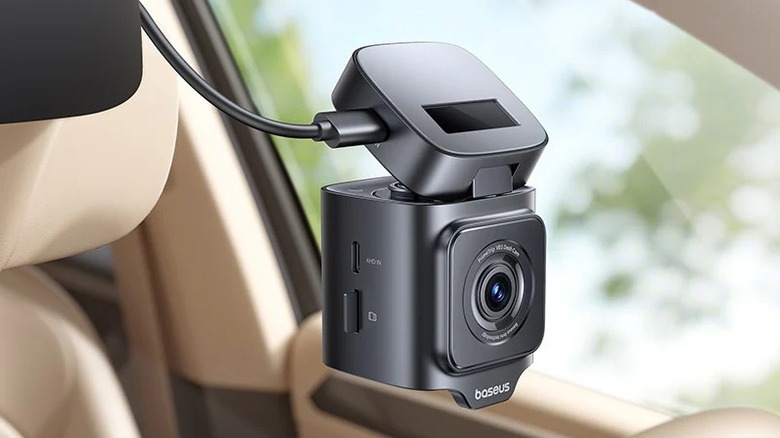
The Baseus PrimeTrip VD1 Pro utilizes a Solar Sync System 2.0 that combines a 380mAh lithium battery with an integrated solar panel to provide up to 14 days of parking monitoring without requiring a hardwired connection to the vehicle's fuse box. This is a significant shift in vehicle security logic. Instead of leeching from the car, the unit uses its onboard lithium battery to power motion detection and impact sensors.
Thermal Limits and Efficiency
When the car is parked, the system enters a low-power state. If the G-sensor detects an impact or the motion detection triggers, the device automatically records 30-second video clips and saves them to a secure folder. The solar panel, mounted on the top of the casing against the windshield, trickles charge back into the 380mAh battery whenever the sun is out.
Critics often ask: do solar dash cams drain car battery? The answer here is a firm no. Because the parking surveillance is entirely decoupled from the car’s electrical system, there is zero risk of parasitic drain. However, one must consider the environment. The VD1 Pro is rated for thermal limits up to 150°F. In extreme climates like Arizona or Dubai, the heat inside a parked car can exceed this, which might impact the longevity of any lithium-based dash cam for parked car use. For most temperate and subtropical regions, the solar vs hardwired dash cam for parking mode debate leans heavily toward solar for the sheer sake of convenience.
Installation & Connectivity: The DIY Reality
One of my favorite aspects of this 4K dash cam review is the DIY installation. Most high-end 4K cameras require you to tuck wires into the headliner, run them down the A-pillar, and tap into a fuse with a multimeter. With the VD1 Pro, the primary power comes from a standard 12V power outlet (the cigarette lighter) or a USB port.
The Setup Process
- Mount the front unit behind the rearview mirror where the solar panel has a clear view of the sky.
- Route the rear camera cable along the floor mats or headliner to the back window.
- Plug the front unit into the 12V power outlet.
- Download the Baseus app and pair via Wi-Fi 6 connectivity.
The inclusion of Wi-Fi 6 is a massive upgrade over the older 2.4GHz bands found in cheaper units. Transferring a 400MB 4K video clip to your phone can take minutes on older tech; here, it takes seconds. However, there is a technical friction point to note: wireless CarPlay and Android Auto also use Wi-Fi. If your phone is connected to your car's infotainment system, you may need to temporarily disconnect to view the live feed from the solar dash cam on the mobile app integration.
Comparing Power Configurations
| Feature | Baseus VD1 Pro (Solar) | Traditional Hardwired 4K Cam |
|---|---|---|
| Installation Time | 15 - 20 minutes | 1 - 2 hours |
| Tool Requirement | None | Multimeter, fuse taps, crimpers |
| Parking Mode Power | 380mAh Internal + Solar | Vehicle Lead-Acid Battery |
| Vehicle Compatibility | All vehicles with 12V outlet | Requires compatible fuse box |
| Risk of Dead Battery | Zero | Low (if voltage cutoff fails) |
Verdict: Is the Baseus VD1 Pro Worth It?
After analyzing the Baseus VD1 Pro solar dash cam parking mode performance, it is clear that Baseus has identified a specific niche: the "active but non-technical" driver. This is someone who wants the best 4k dash cam with solar parking protection but has no interest in taking their dashboard apart.
The combination of the Sony IMX335 sensor and the F/1.6 aperture provides the imaging precision required for modern insurance claims. While the question of how long does solar dash cam battery last in winter remains—as shorter days provide less charging time—the 14-day standby claim offers a generous buffer for most users.
Pros
- Outstanding 4K video clarity thanks to the Sony Starvis sensor.
- Zero risk of draining the car's main battery during parking mode.
- Incredibly fast Wi-Fi 6 connectivity for video downloads.
- 170-degree wide-angle lens provides comprehensive coverage.
Cons
- The rear camera still requires a physical cable to be routed through the cabin.
- Internal lithium batteries have a finite lifespan compared to supercapacitors.
- App connectivity can conflict with wireless CarPlay.
If you are looking for a high-performance solar dash cam that simplifies vehicle security, the VD1 Pro is a compelling choice. It offers the imaging tech of a pro-grade camera with the setup ease of a consumer gadget.
FAQ
Is there a dash cam that is solar powered?
Yes, the Baseus VD1 Pro is a prime example of a solar dash cam. It features an integrated solar panel on the housing that faces the windshield, designed specifically to replenish its internal battery for use during parking monitoring.
How does a solar powered dash cam work?
A solar dash cam like the VD1 Pro operates on a hybrid system. While you are driving, it draws power from the vehicle's 12V outlet to power the camera and charge the internal 380mAh battery. When the car is parked, the camera switches to its internal battery, which is maintained by the energy harvested from the solar panel.
Can a dash cam run entirely on solar energy?
Currently, most dash cams cannot run 24/7 entirely on solar energy for driving and recording because 4K sensors and Wi-Fi modules require more power than a small integrated panel can generate. Solar is primarily used to supplement the battery for parking mode, not as the sole power source for continuous driving recording.
Do solar dash cams record while the car is parked?
Yes, they do. The Baseus VD1 Pro uses its solar-charged battery to stay in a standby state, using a G-sensor and motion detection to trigger 30-second recordings if an event is detected near the vehicle.
Do solar dash cams charge on cloudy days?
Solar panels can still generate electricity on cloudy days, though the efficiency is significantly reduced compared to direct sunlight. The 14-day standby time of the VD1 Pro is designed to provide a buffer for periods of poor weather, ensuring vehicle security remains active even during a week of rain.