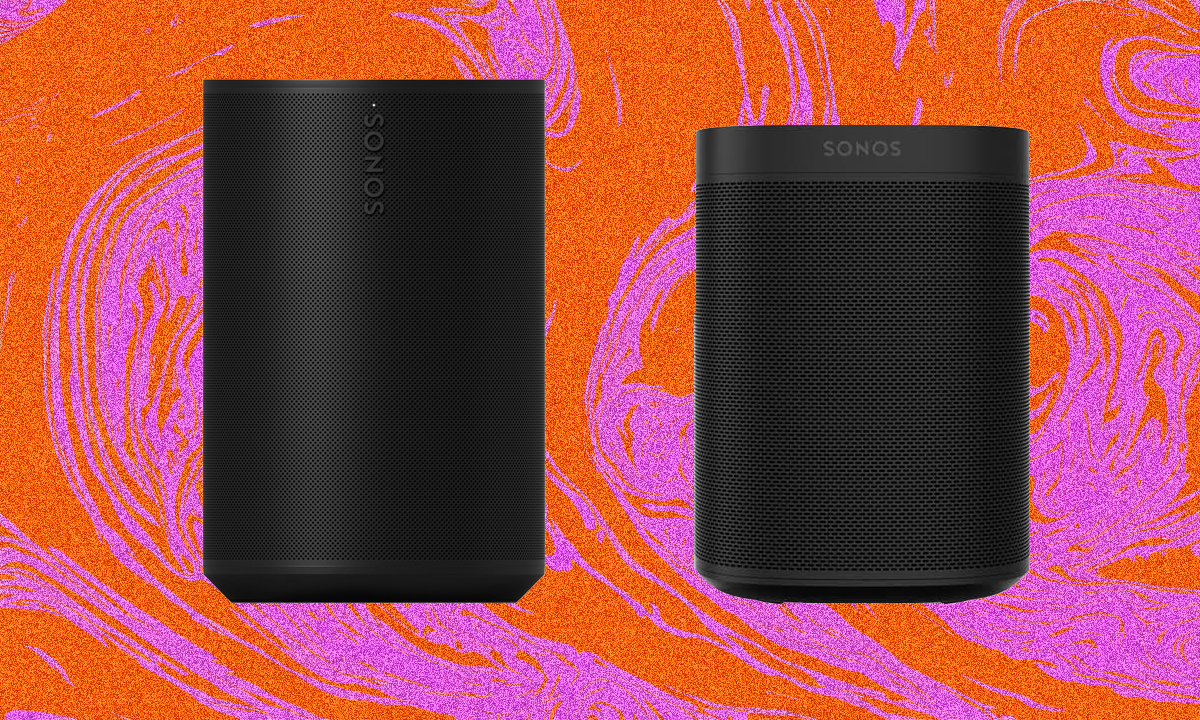
The debate of Sonos Era 100 vs Sonos One often comes down to one question: is the new hardware worth the $50 price jump? Released in 2023, the Era 100 represents a total overhaul of the legendary Sonos One. While the One served as the gold standard for compact smart speakers for years, the Era 100 introduces native stereo sound, Bluetooth, and a versatile USB-C line-in. In this guide, we examine the Sonos Era 100 vs One technical specifications and real-world performance to help you decide.
Quick Facts
- Price: The Era 100 retails for $249, while the Sonos One launched at $199.
- Audio Architecture: Era 100 features a dual-angled tweeter array for stereo sound; Sonos One is mono.
- Bass Performance: Era 100 has a 25% larger woofer for significantly deeper low-end response.
- Connectivity: Era 100 adds Bluetooth 5.0 and a USB-C line-in; Sonos One is Wi-Fi only.
- Processing Power: The Era 100 features a 47% faster processor for quicker response and future-proofing.
- Energy Efficiency: Idle power consumption is reduced by 50% on the Era 100 compared to its predecessor.
- Voice Support: Era 100 supports Alexa and Sonos Voice Control but removes Google Assistant.
The Sonos Era 100 is a significant upgrade over the Sonos One, offering native stereo sound through a dual-angled tweeter array, a 25% larger woofer for deeper bass, and the inclusion of Bluetooth and Line-in connectivity. While it costs $50 more, its future-proofed hardware makes it the superior choice for new buyers, though current One owners may only find it worth the upgrade if they need Bluetooth or turntable support.
Acoustic Architecture: Stereo vs. Mono Performance
When I first unboxed the Era 100, the physical changes were apparent, but the real magic happened when I pressed play. For years, the Sonos One reigned supreme because it packed incredible punch into a small frame. However, it was always a mono speaker. If you wanted stereo, you had to buy two and pair them. The Era 100 changes that dynamic entirely by moving to a next-gen acoustic architecture.
Inside the Era 100, you will find two dual-angled tweeters directed to the left and right. This design creates a stereo sound from a single unit, providing a sense of space and separation that the Sonos One simply cannot replicate. In my testing, listening to complex jazz arrangements or live recordings felt far more open. You get an immersive soundstage that fills the corners of a room rather than firing audio from a single point.
The low-end has also received a massive boost. The Sonos Era 100 is equipped with a mid-woofer that is 25 percent larger than the one in the Sonos One. In a Sonos Era 100 vs Sonos One audio performance comparison, the difference in bass authority is striking. The Era 100 doesn't just play louder; it plays deeper with more control. This improvement is powered by three Class-D digital amplifiers, ensuring that even at high volumes, the mid-range remains clear and undistorted. Whether you are looking for Sonos Era 100 vs Sonos One bass response differences or overall clarity, the newer model is the clear winner for near-field listening and medium-sized rooms.
Connectivity Revolution: Bluetooth, Wi-Fi 6, and Line-In
For years, the biggest complaint about the Sonos One was its "walled garden" approach. It relied almost exclusively on Wi-Fi and Apple AirPlay 2. While the Sonos S2 controller app is excellent, the lack of flexibility was a pain point. The Era 100 solves this by embracing a more open philosophy.
The headline addition is Sonos Era 100 Bluetooth support vs Sonos One connectivity. You can now pair your phone directly to the speaker without needing a Wi-Fi network. This is a lifesaver when friends want to play a quick track or when your home network is acting up. Furthermore, the inclusion of the Wi-Fi 6 standard ensures a more stable connection in modern homes crowded with smart devices.
Perhaps the most exciting update for vinyl enthusiasts is the USB-C line-in port. In the past, connecting turntable to Sonos Era 100 vs Sonos One was a lopsided battle; the One simply didn't have an input, forcing you to buy a much more expensive Five or a Port. With the Era 100, you can use the Sonos Line-In Adapter (sold separately for $19.99) to plug in analog sources directly. This makes the Era 100 the most affordable way to get your records playing across your entire whole-home audio ecosystem. When looking at the Sonos Era 100 vs One technical specifications, these connectivity gains represent the most significant "quality of life" improvement in the Sonos lineup in a decade.
Smart Features and The Ecosystem Trade-off
Smart speakers are only as good as their brains and their integration into your daily routine. The Era 100 features a processor that is roughly 47% faster than the one in the Sonos One. This might not sound like much on paper, but in practice, it means the speaker wakes up faster, groups more reliably, and is better prepared for future software updates over the next 10 years.
One of the most welcome software updates is the expansion of Trueplay room tuning. Previously, you needed an iPhone to tune your Sonos speakers to your room's acoustics. With the Era 100, Sonos introduced "Quick Tuning," which uses the speaker's own built-in microphones to calibrate the sound. This means Android users can finally enjoy a optimized listening experience without borrowing a friend's iPhone.
However, there is a catch regarding Sonos Era 100 voice assistant vs Sonos One Google Assistant support. While the Sonos One supported both Alexa and Google Assistant, the Era 100 drops Google Assistant entirely. This is likely due to ongoing legal and technical disputes between the two companies. You still get Sonos Voice Control integration for music-specific commands and Amazon Alexa for general smart home tasks, but if your home is built around the Google ecosystem, this might be a dealbreaker. On a more positive note, Sonos has made great strides in environmental sustainability materials, using recycled plastics and a design that is easier to repair, which is a nice bonus for the eco-conscious buyer.
The Verdict: When to Upgrade or Stand Pat
So, is Sonos Era 100 worth the extra cost? The answer depends entirely on how you plan to use it. The Sonos Era 100 launched on March 28, 2023, at $249, which is a $50 premium over the Sonos One.
If you are buying a standalone speaker for a kitchen, office, or bedroom, the Era 100 is worth every penny of that price difference. The jump from mono to stereo and the addition of Bluetooth makes it a far more versatile device. For those specifically looking at is Sonos Era 100 worth the price difference over Sonos One for music, the answer is a resounding yes. The improved bass and wider soundstage make it feel like a much larger speaker than it actually is.
However, the calculation changes when discussing Sonos Era 100 vs Sonos One as surround sound speakers. If you already have a pair of Sonos Ones acting as rears for your Beam or Arc soundbar, the upgrade is less urgent. While the Era 100 does provide a more immersive performance due to its angled tweeters, your soundbar still does the heavy lifting. In this scenario, existing owners should probably stick with what they have.
Finally, for those wondering should I upgrade from Sonos One to Era 100, the "killer app" is the line-in. If you have been waiting for a compact speaker to pair with your turntable, the Era 100 is the upgrade you have been waiting for. With its 50% improvement in idle power efficiency, it's also a speaker that will save you a few dollars on your energy bill over the long run.
FAQ
What are the key differences between the Sonos Era 100 and Sonos One?
The Era 100 provides stereo sound via two tweeters, whereas the Sonos One is mono. The Era 100 also adds Bluetooth connectivity, a USB-C line-in, and a larger woofer for better bass. Additionally, the Era 100 supports a faster processor and Wi-Fi 6 but removes Google Assistant support.
Is the Sonos Era 100 worth the upgrade from the Sonos One?
It is worth the upgrade if you need Bluetooth, want to connect a turntable via line-in, or desire a wider stereo soundstage from a single speaker. If you only use your speaker for background music or as a rear surround in a home theater, the Sonos One remains a very capable device.
Does the Sonos Era 100 support Bluetooth connectivity?
Yes, the Era 100 features Bluetooth 5.0, allowing you to stream audio directly from any paired device. This is a major upgrade over the Sonos One, which was limited to Wi-Fi and AirPlay 2.
Can the Sonos Era 100 be used as rear surrounds with a soundbar?
Yes, the Era 100 can be paired with Sonos soundbars like the Arc, Beam, and Ray to act as rear surround speakers. Because of its angled tweeters, it offers a more expansive rear soundstage than the Sonos One.
Does the Sonos Era 100 have a line-in port?
Yes, the Era 100 has a USB-C port on the back that supports line-in connections. You will need the Sonos Line-In Adapter to connect traditional 3.5mm audio cables from devices like turntables or CD players.